
Introduction
In industrial fluid control, a common misconception among piping engineers is treating all ball valves as identical. While they share a spherical closure mechanism, the fundamental difference between a V-port ball valve and a standard O-port ball valve dictates whether your pipeline achieves precise flow modulation or reliable zero-leakage isolation.
Selecting the wrong valve type can lead to severe cavitation, rapid seat wear, and system instability. In this technical guide, BSO Ballseal breaks down the core mechanical differences, flow characteristics, and critical selection criteria to help you optimize your process systems.
1. The Core Mechanical Difference: Bore Geometry
The defining distinction lies in the shape of the ball’s port (bore) and how it interacts with the valve seats during operation.
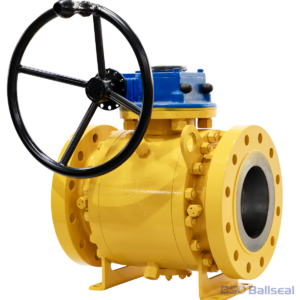
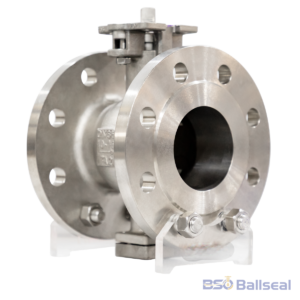
- Standard Ball Valves (The Isolation Experts): Featuring a traditional round bore (O-port), this design creates a straight-through flow path when fully open. It minimizes pressure drop and turbulence. When rotated 90 degrees to the closed position, the solid spherical surface provides a tight, symmetrical seal against the seats.
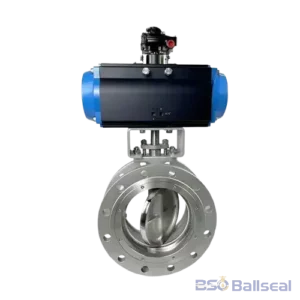
- V-Port Ball Valves (The Control Specialists): Instead of a round hole, the ball features a precision-machined V-shaped notch (commonly 15°, 30°, 60°, or 90°). As the valve actuates, the V-notch exposes the flow area gradually. This specialized geometry allows for exact throttling and linear flow control, rather than simple on-off action.
2. Flow Characteristics & Performance
Understanding the flow curve is critical for automated systems and EPC project specifications.
The Quick-Opening Curve of Standard Ball Valves
Standard round-port valves exhibit a “quick-opening” characteristic. The majority of the flow increase happens in the first few degrees of rotation. If you attempt to use a standard ball valve for flow regulation (throttling), the high-velocity fluid will strike the partially exposed seat, leading to rapid erosion, severe vibration, and eventual seal failure. Their primary duty is strictly On/Off isolation.
The Equal-Percentage Control of V-Ball Valves
V-port valves are engineered to provide an “equal-percentage” or near-linear flow characteristic. The V-notch acts as a precise mechanical orifice, allowing flow capacity to change proportionally with the valve’s rotational angle. This guarantees stable pressure control and eliminates the turbulence and noise associated with standard valves in partial-open positions.
3. Media Handling & Shearing Action
Your pipeline’s media dictates the valve’s survival rate.
- Clean Media: Standard ball valves perform exceptionally well with clean liquids, gases, and steam. However, if solids are introduced, particles can become trapped between the symmetrical seat and the ball, causing scoring and leakage.
- Harsh & Fibrous Media: V-port ball valves excel in severe services. The sharp edge of the V-notch creates a powerful shearing action against the contoured seat as the valve closes. This mechanism effectively cuts through fibers, pulp, and slurry buildup, preventing clogging and ensuring a tight shut-off even in highly viscous environments.
(At BSO, we understand that harsh media demands robust materials. We provide genuine EN 10204 Type 3.1 MTCs and conduct on-site PMI testing to guarantee that the stainless or alloy steel used in our V-port valves meets the exact metallurgical requirements of your abrasive applications.)
4. Head-to-Head Technical Comparison
| Feature | Standard Ball Valve | V-Port Ball Valve |
| Bore Geometry | Round (O-Port) | V-Shaped Notch |
| Primary Function | Zero-leakage Isolation (On/Off) | Precise Flow Modulation |
| Flow Characteristic | Quick-Opening | Equal-Percentage / Linear |
| Media Handling | Clean liquids, gases, steam | Slurries, viscous fluids, fibers |
| Shearing Ability | None | Excellent |
| Seat Design | Symmetrical | Contoured |
5. Lifecycle Cost & Maintenance Considerations
Procurement teams often focus on initial capital expenditure, but engineering logic demands a total cost of ownership (TCO) evaluation.
Standard ball valves have a lower upfront cost and are highly economical for general isolation duties. However, forcing them into throttling applications guarantees frequent maintenance downtime and seat replacements.
Conversely, while V-port valves require a higher initial investment due to precision machining and specialized contoured seats, their engineered wear resistance and uniform modulation significantly extend their service life in control loops, ultimately reducing lifecycle costs.
Conclusion: Making the Right Engineering Choice
The decision is straightforward: if your system requires absolute shut-off and minimal pressure drop, specify a Standard Ball Valve. If your process demands continuous flow regulation, pressure reduction, or the handling of abrasive slurries, the V-Port Ball Valve is the undisputed choice.
Engineered Precision, Delivered with Transparency.
Whether you need high-capacity isolation or precise modulation, BSO Ballseal ensures every valve is strictly tested. All our products undergo 100% hydrostatic shell and seat pressure testing (API 598 / EN 12266-1) with full inspection records before dispatch.
Need technical support for your current project? Upload your GA drawings or piping specifications on our Contact page, and our engineering team will provide a precise, customized quote within 24 hours.
Looking for High-Performance V-Port Ball Valves?
BSO Ballseal manufactures precision-cast V-port ball valves designed for exact flow modulation and severe industrial services. Ready for turnkey automation.